
Mapping These Walks: A Cartography Of Adversity And Remembering
Signs are not reality. Yet both are latent in the games of our maps, and in the maps of our games.

Last time, we talked about walking as a foundation to the perception & understanding of reality. We also saw how walking is also a foundational mechanic in almost every video game out there. Importantly, we said walking starts various series in the middle of the world’s course of cause and effect; that its power to initiate new causality is not necessarily salutary, but possibly so.

This is where we pick up today: walking’s aptness to free is not without ambiguity. We’ve mentioned the tensions between intensity and extensivity, between empirical and systemic unity, ultimately between the object and its representation.
Despite being at the root of further causality, walking does not clarify the relation between object and representation, between what I know (the object for me) and what I don’t know that I don’t know (the object for itself). On the contrary, it complicates that relationship.
Why? Because for some reason we are very tempted to live on the map we elaborate1 and this is what I want to elucidate in this post. The fundamental tension here is that signs are not reality, but we have to contend with both. Both exist in very comparable measure: we speak and elaborate meaning in words, but only practice shapes the world and understands itself; between the language of words and the language of praxis, it’s unlikely the two communicate directly. More problematically, it seems to me we also often don’t know which is sign and which is reality: when is the map faithful to reality, and how much so?
Such a problem calls for a methodological strategy to help me better understand the problem. Not just how I come to know of it (only epistemological), nor if there is any clear manner in which to overcome it (pragmatic-dogmatic). I need a kind of genealogy of closing in on the issue, so that no matter the circumstances that arise before me, I can always reliably reproduce the principle of its understanding. Reproducibility is, after all, the prime concern of any methodology fitting of the label.
As has become the habit, I want to explore this subject by doing some game design analysis. The reason is simple and intuitive: as soon as you (the player) are given a map (ex. open-worlds) or even more egregiously a mini-map (ex. Diablo), you start staring at it more than you do at the environments you find yourself in. You begin to play the game through the map rather than the actual environment.
And this is super understandable! The first thing we do is to learn the game, to make our own mental map of its basic game loop, of its controls, of its sound cues, and so on. So when the game “helps” us by giving us a ready-made map, the brain jumps on the occasion to conserve energy and focus on other pressing matters (ex. landing headshots, criticals). But it also robs us of the experiences & perceptions that we would have needed to make that mental map.
In the final analysis, the mental map that becomes our cognitive interface with the game has a very powerful function: to alleviate friction and smooth out the asperities and challenges of playing it. Its prime purpose is to evacuate as much ambiguity as possible from the situation. This is the dialectic, the tension of being in a relationship with reality but also living on the map, in the purity of its unequivocal signs.
System Shock, SHODAN, and the mapping of adversity
System Shock (played the 2023 remake) starts you as “The Hacker”, living somewhere on a station near Saturn and trying to steal a bio-implant from the TriOptimum Corporation; you’re arrested and then told you’ll be given the implant on the condition you remove the AI’s “ethical restraints” (dude, have you read the news recently?). You undergo the procedure, go into a healing coma, and then wake up to the realization that everything has gone to shit on the station, SHODAN (the aforementioned AI) has taken control, there are cyborgs and zombies and robots run amok?!?!
From this point on, you are literally in the dark. There are no other characters to guide you along. Everybody seems to be dead or transformed into cyborgs. You have no idea where you are or what you’re supposed to do; nobody tells you. This is the first moment of adversity: you have to figure some of this shit out, so you start smacking some zombies, collecting some audio logs and getting your bearings; the first moment of mapping.
The UI does all the work here: you install augmented vision implants that can show you your inventory (quite small and limited, another facet to overcome), your map (initially blank, fills in as you go) and the “media” tab (where you can re-read your collected logs). But wait a minute! This whole thing is NOT a separate menu, it’s an in-game thing, there’s no pause. WHY am I getting hit, I thought I had smashed all the zombies on Medical?!?!
It turns out SHODAN (whose acquaintance you quickly make) feels very strongly against your presence. One of the things she does is send enemies through THE FLOOR. You can never rest easy unless you bring down the level’s security to 0%, which involves searching for the CPU Nodes (heavily guarded) and destroying them. Oh and there’s security cameras too.
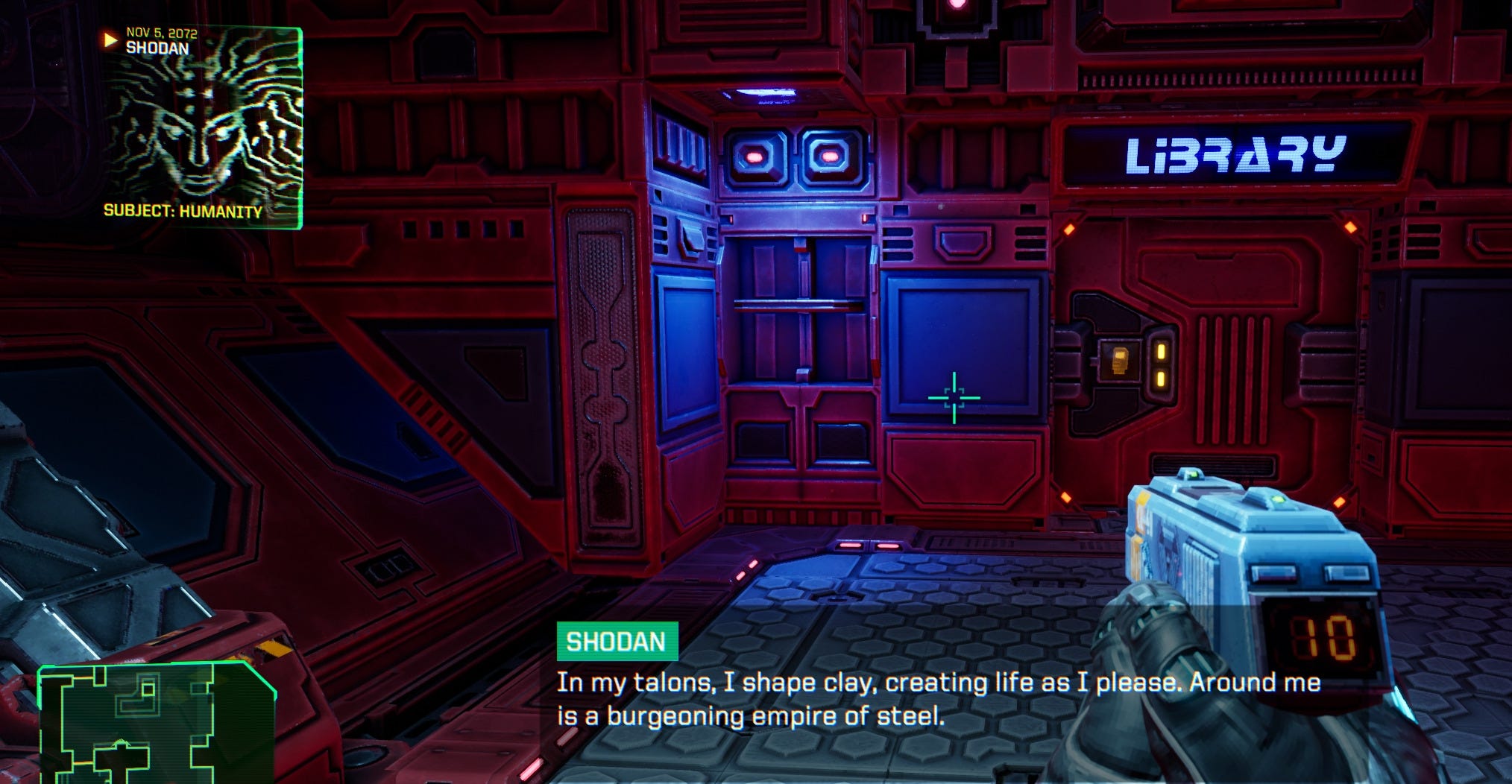
SHODAN is a great narrative excuse for making the environment dynamic & unpredictable, perfect for keeping the player on their toes. It also immerses into the game space; from the very first scene, you understand how much you can interact with the environment in a tactile way. This becomes all the more obvious when the environment also starts to interact with you, disturbing you and making you (most often) panic-react.
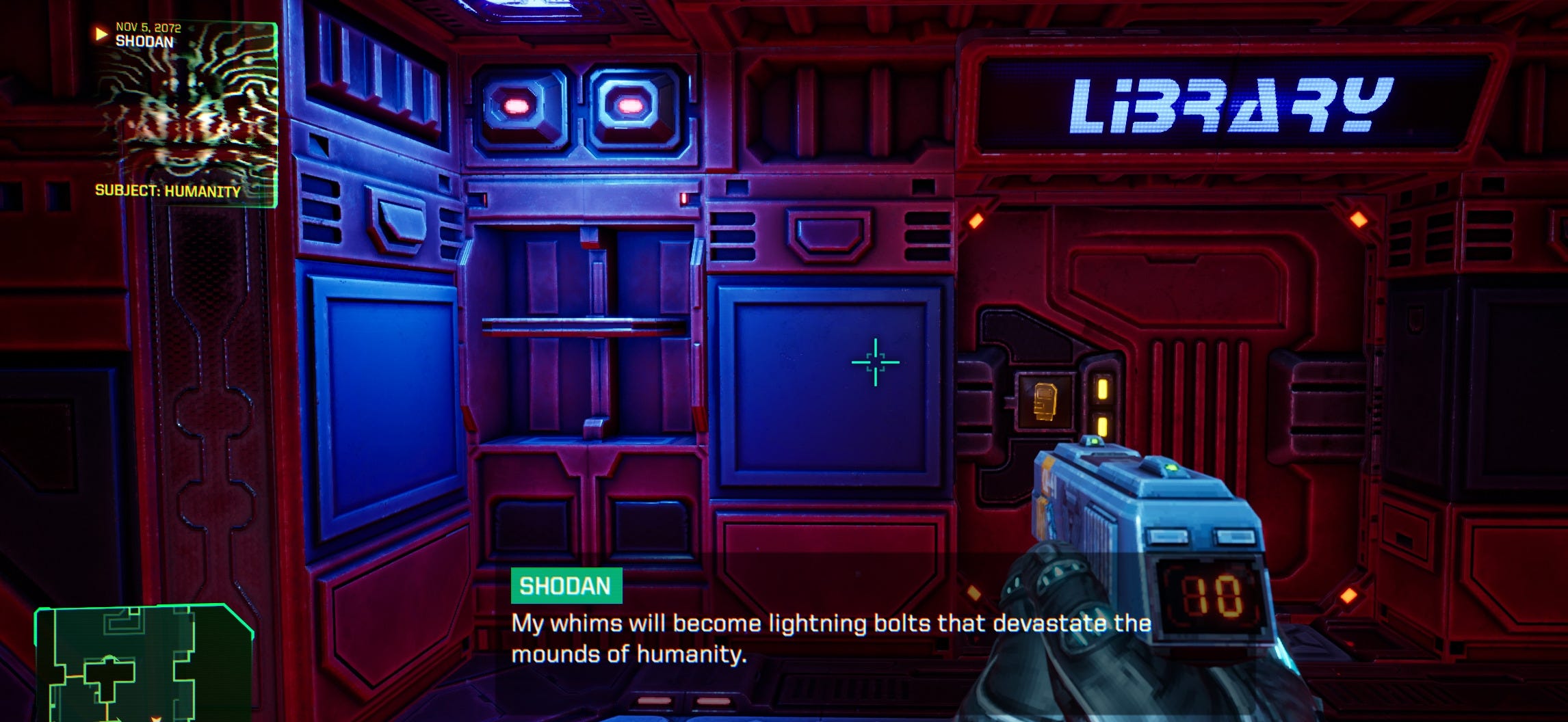
This is the game’s second moment of mapping: you don’t just figure out the puzzle of its environment, the meaning of its story and your place in it. You startingly realize the space has become a second moment of adversity. In this way it has become a place. In other words, when immersion happens, it doesn’t just happen; it takes place. You don’t know when the floor is going to open and send goons your way (most often when you have your back turned or have just left the room), and you also realize there are secret doors you can interact with, which are very rare but you can figure out their placement from looking at the map and understanding its topology (hello topological sorting from data structures class!). Thus you are PRIMED, always looking for nooks and crannies where the enemy might be, or where you might be able to open a secret door, or finally find some much needed resources.
It’s not a mystery how much work went into trying to never let the player rest on his laurels. I had just finished executive, and had to return to a “lower” level (Storage) to get my Enviro-Suit. I was cocky because executive had been hard and this was supposed to be easier. But I still fell into one of SHODAN’s traps, where she proceeded to congratulate me by throwing rooms of enemies at me.
“Great jump, insect.”
In an interview with RPS, one of the former developers on the game says: “We wanted SHODAN to feel like this presence. We wanted a sense that she was all around, literally the ghost in the machine, running the whole station. I remember the designers saying they wanted you to hate SHODAN not just because you were told to, but because you experienced her messing with you directly.”
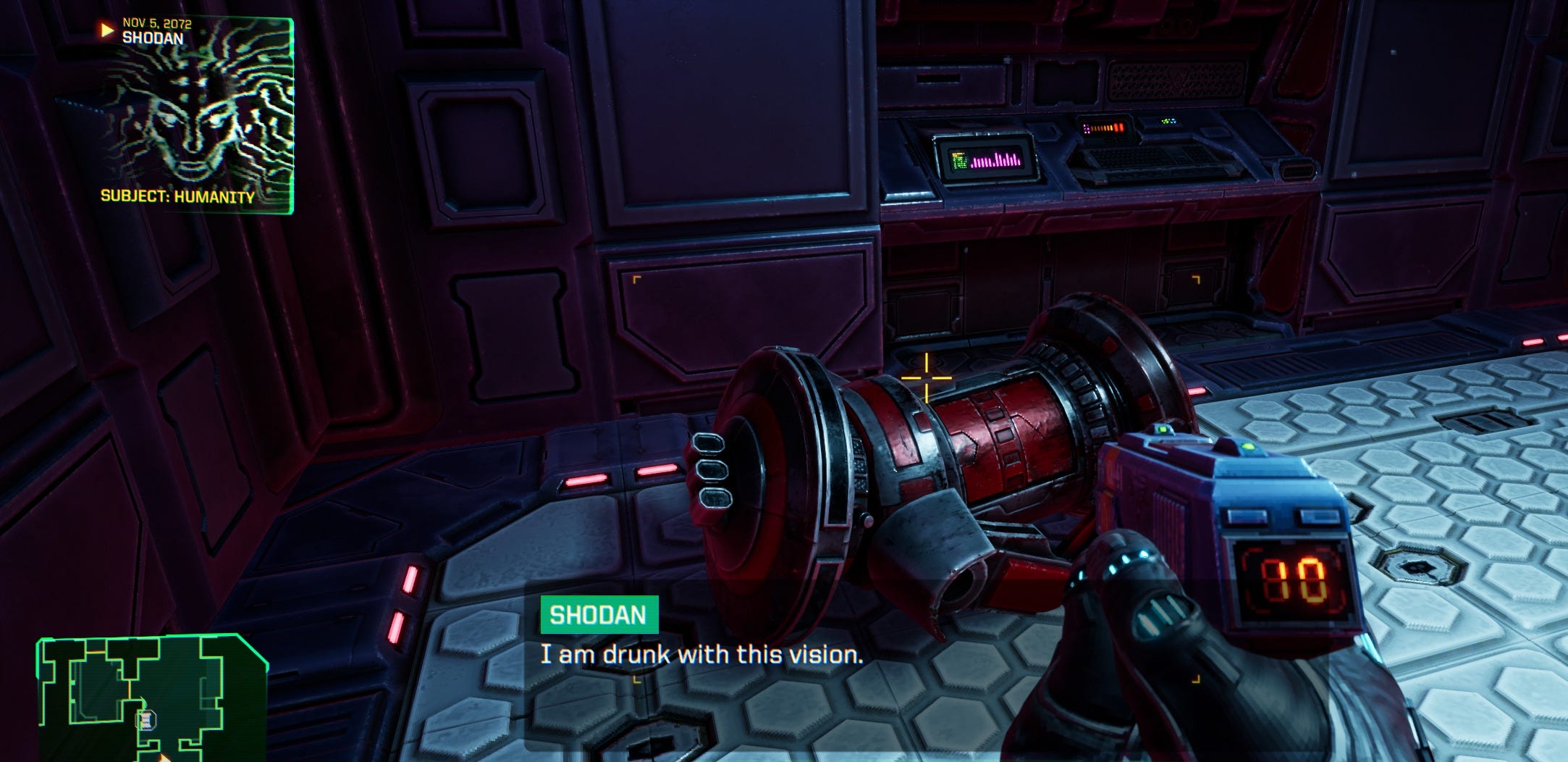
The first moment of mapping was getting your bearings and figuring out the UI, literally interfacing with the game. The second was getting to face SHODAN and constantly trying to adapt to its vexing hazards. But we’re not done. While these two help you make a map of your bearings (north, shelter, danger) and get you to figure out that zone of “here be dragons”, there is something else in map-making. It’s more mundane and yet so much more essential: figuring out distances, measuring them, using instruments, calculating angles, having a sense of scale, reworking past mistakes, and so on.
This is System Shock’s great achievement: it doesn’t drop you into its world and let you go on auto-pilot. You always have to untangle some mess, remap previous assumptions, use new approaches of disassembly. And as you conquer its challenges, you are actually conquering your own initial inability to understand it.
For the game’s project leader, Doug Church, it mattered that “games [should have] the potential to be more than just a way to pass some time.” (RPS interview) There is a third moment of mapping in this game, a bit different from the first two and from many other computer games out there. It is not a third moment of adversity, but a recurring one.
I want to hammer this home because it’s crucial to our initial discussion of the issue of mapping. We evoked the tension of somehow being in a relationship with reality but also mostly living on the map. What System Shock helps us figure out is that this tension/dialectic is one of recursion. I will explain how the game does it, but first I really want to define recursion as that process when “a method calls itself”, as it is defined in computer science. It is not simply repetition, but the invocation of a method on an (ideally) changing “argument” until it reaches a status compatible with the method’s base-case. At that point and only at that point, the recursion unwinds, regressing back to its initial call that must be closed.
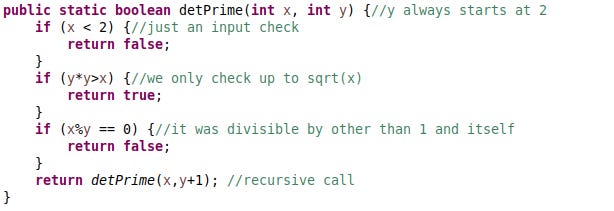
The best way I can find to explain “what is going on here” is to compare recursion with its iterative equivalents. Every operation you can do with a recursive loop you can do with an iterative loop. There should be no practical difference in the result that it gives as an output of the program. But there is a massive difference 1) for the programmer having written the program and the reader of that program and 2) for how the program executes on hardware. The writing becomes elegant, short, profound. But the price you pay is that the compiler has to open stack frames for each recursive call, and for a very large chain of such calls you might just blow your stack, get a memory error & crash your program (worst case), even without considering the (minor??) performance slow-down (in every case).
The most important part here, and how we get back to System Shock, is that when you’re writing recursive code, you stop thinking about it; it just works. You kind of understand what is going on, but no longer at a precise scale, and yet it works. That’s it, that’s the magic: not understanding exactly. Cynical, maybe, but realistic. The magic happens when something works without you understanding how, and reliably so.
You could make a game with the same kind of ambition for immersion by focusing on in-game interfaces and a villain that has discursive AND objective adversarial powers. But if you made it the iterative way, it wouldn’t work, the magic wouldn’t hold. In my opinion, this is what Bioshock tried to do and failed. You have your splicing power (in-game interfacing), and you have your magnetic villain (Andrew Ryan), but the mind can see through the veil; it recognizes the looping, the design patterns, the rhythm of it. The immersion doesn’t hold because your map is complete, and you can live on it.
In System Shock, there is a gradation within the game that you can observe only in retrospect. Only once you’ve unwound the recursion can you account for the adversity you’ve been in, because the game doesn’t let you live on the map. Much of that is owed to its non-linearity and absence of quest markers. But the essential part is how it ratchets up resource & ammo scarcity, health management (balance between dangerous enemies and availability of healing), knowledge keys (I had to write down directions, places of importance, and codes in a real-life notebook I held next to me), and enemy type weaknesses, not to mention the problem of radiation and (if playing on the highest difficulty) time constraint.
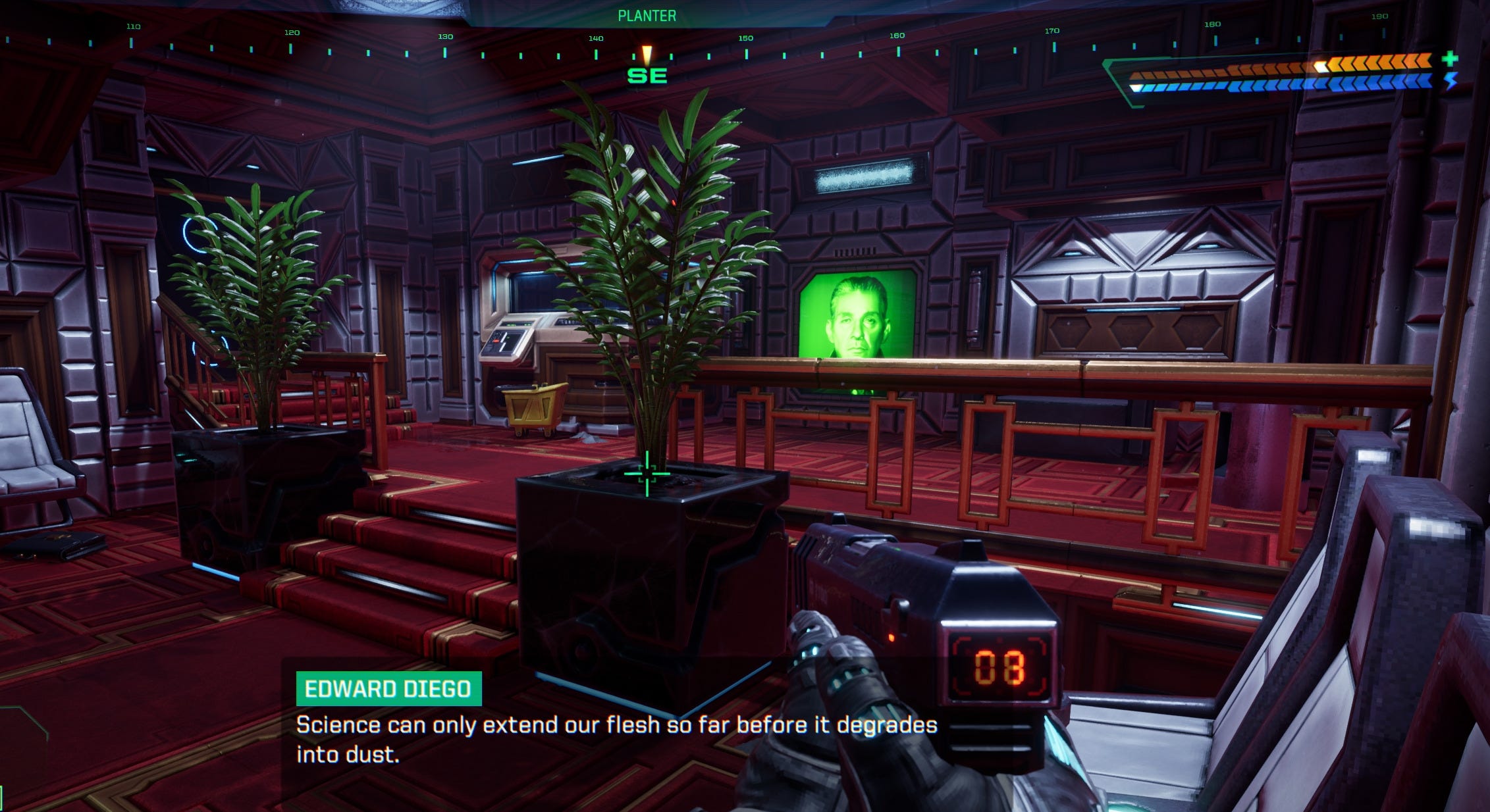
Much like writing recursive code, you are disassembling the problems the game is throwing at you and choosing how to reassemble your own solution to them in real-time. And every new problem tends to come with the difficulties that you had solved before in addition to a new one, so you’re constantly re-using your previous knowledge (much like a method calling itself and working on its argument until it reaches a base case). And if you don’t remember your previous knowledge? The game is cool that way because what it actually teaches you is the approach. Once you’ve understood that your true enemy is cognitive overload, each time you know that there is a solution. You must search for it and you need only apply yourself to it. It’s a very interesting feeling, ultimately, that there are these seemingly impossible challenges, immense levels, and unapproachable enemies that the game throws at you. It seems that way, but the game’s design is telling you they’re not; just use your head. Quite the opposite of habitual entertainment experiences.
That’s why it works. There’s no way you can track all the variables the game smashes on your head, but you can kind of work through it by not thinking about it. Isn’t that crazy? The game is telling you to use your head but not think about it. But it’s not crazy: what it’s telling you is keep drawing the map, but don’t live on it.
System Shock is an enduring monolith of gaming’s best experiences. Not because it presses you into a mapping of adversity, but because of how it admonishes and reminds you about the value of the map you’re building; the value is in the improvement of your map-making skills, not in the map itself.
Eastward once more: a journey of the other, for the other, and the mapping of memories
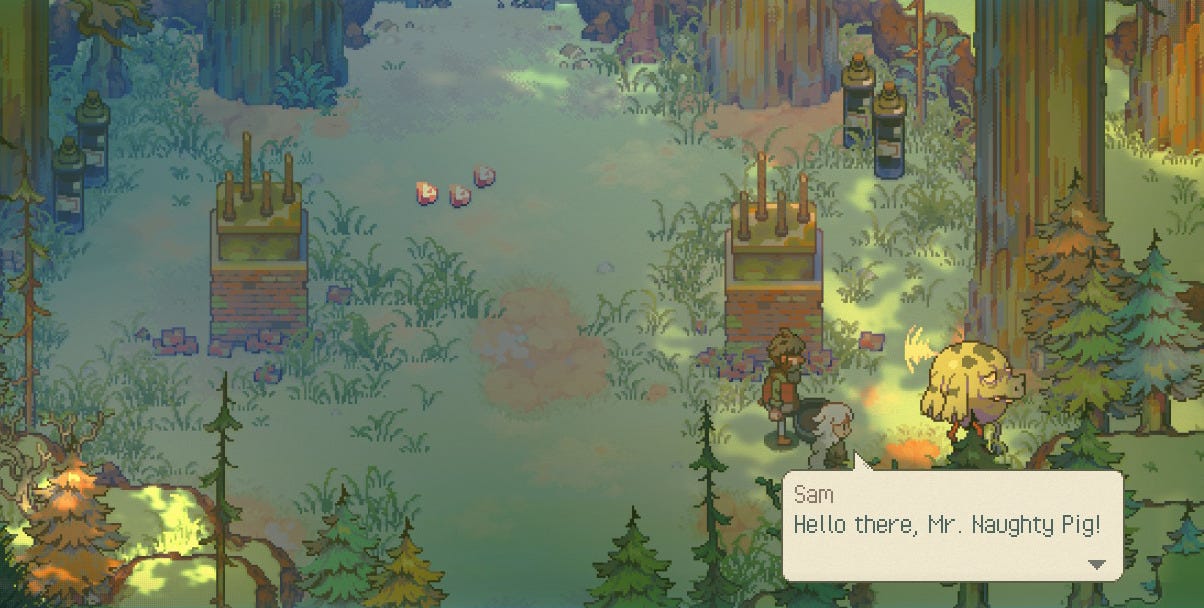
I’ve already gushed about Eastward and its merits. But I had not finished it then, and now I have. It does not follow the three-ish steps of System Shock, objective as they are. Eastward’s spiel is muuuch more subjective, and after looking at reviews and its general place in the zeitgeist, I have an impression this game spoke to me more than anything else and everyone else (reviews were moderately positive). I want to come back to something I said before about it, because it’s a good starting point to what mapping is like here.
What I’ve said previously is that immersion in open-world games like Cyberpunk & GTA had failed me, for reasons that were more particular to me than anything else. Where those games had failed me, Eastward had not. It spoke, attentively and in depth, to themes that concerned me: the importance of individuality in the midst of social mediocrity, the struggle against cynicism and misanthropy, the search for inspiration as nourishment to hope.
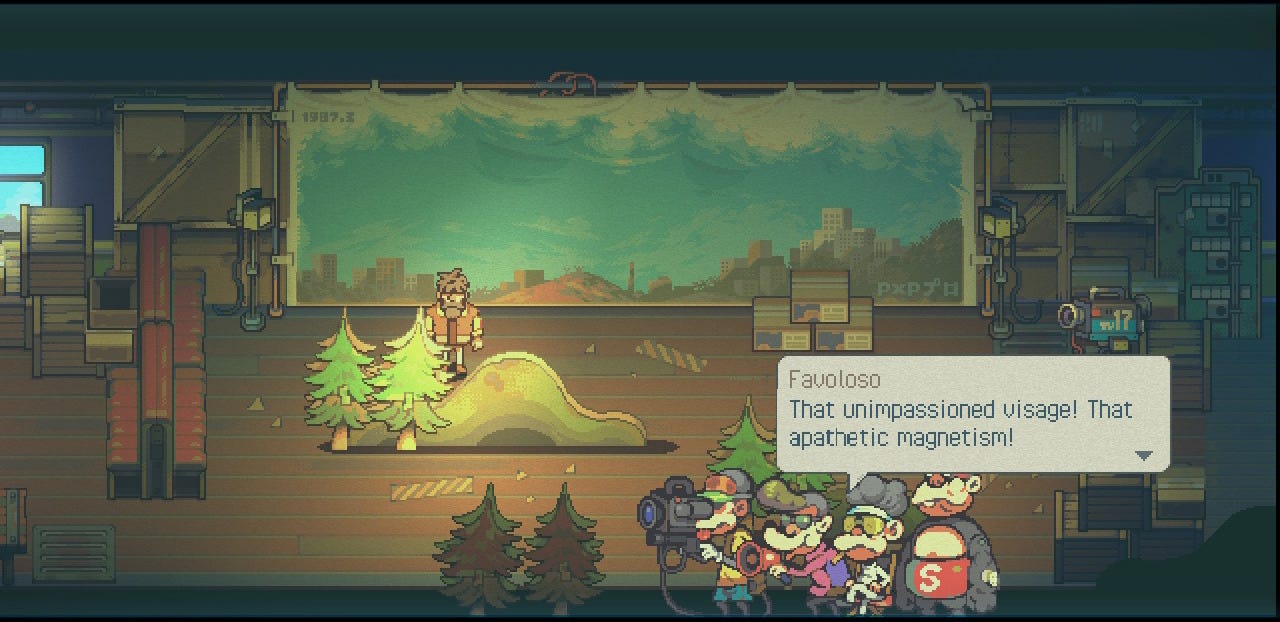
And so it happened that as I played, I started recognizing in it the cardinal landmarks of my own general mapping. I came to understand Eastward as a journey poised on the mapping of personality. It’s an admirable gamble to my eyes. It essentially projects that the way it wants to be is more important than the acceptance of its audience, much like the Emerson quote.
Absolve you to yourself, and you shall have the suffrage of the world.
- Emerson, On Self-reliance
It’s interesting what that means, though, “mapping of personality”. I started by saying that it was subjective, and somehow this is very true, simply by definition. But there is also an objective side to it, and this is what I want to explore further in this section. It’s weird to call something an objective subjectivity, but I want to stick with it.
Let’s start with the beginning. Eastward does a thing where it makes you go through the map when you arrive/begin at a place:
in Potcrock, it’s go to work, go to school, go home, go to the Mayor’s and then go to derelict mall;
in Whitewhale Bay, it’s go to forest, go to village, go to Uva’s, go to cabin, go to ranch, go to village (different), go to cabin (different), RUN;
in NewDamCity, it’s go to... wow this place is big, there are so many places, with their own music and characters and so many things going on (but you go through them all, the game makes you, many times);
in Monkollywood, it’s... complicated, but you’re touring a train over and over and the sets are changing because it’s a filming society (of apes);
finally, in Ester City, you again get to advance the story by (re)visiting every place in an even more egregious manner, because it’s a time-loop mystery... of which YOU ARE A PART;
there are also “dungeons” (Mall, Quake Valley, human factories, Island of Time, Eternal Tower/Charon.
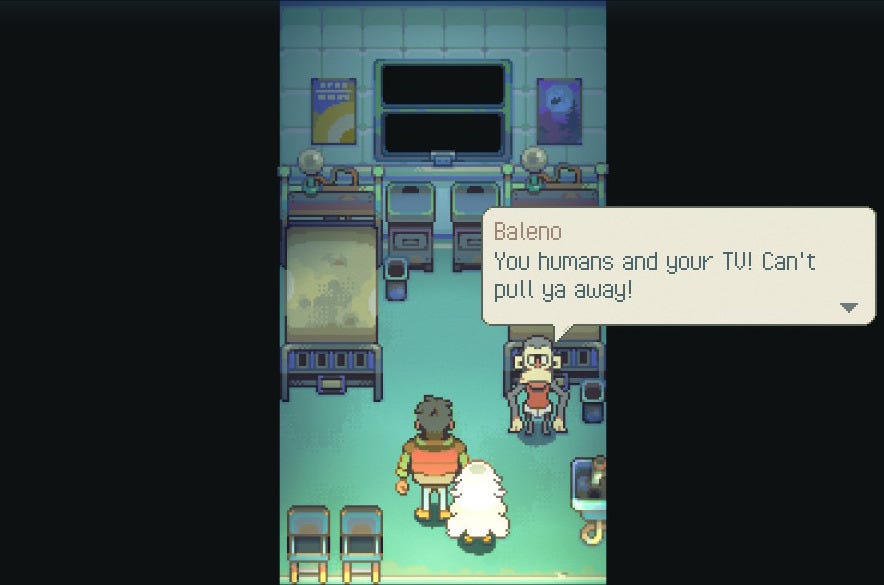
Not only do I remember all of these places in order, but if you woke me up at night, I could take you to wherever you needed to go without using the in-game map. OK, I did look up a guide for the order of the dungeons. But that’s telling, because there isn’t really a mapping of personality within the dungeons. The reason why I remember all the other places is that there’s some kind of character that shows up or that does something strikingly memorable.
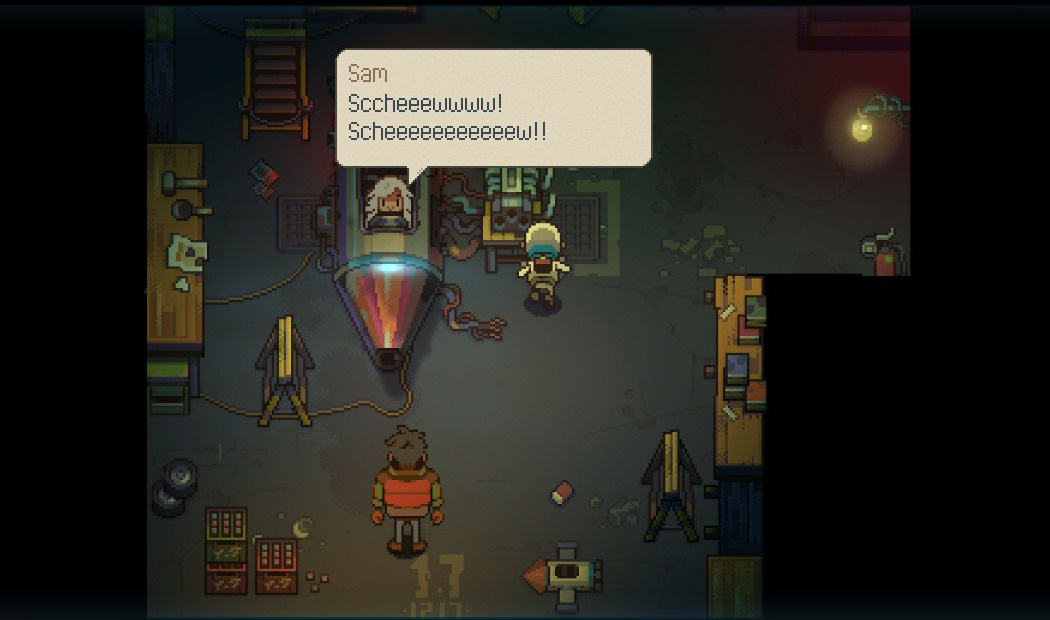
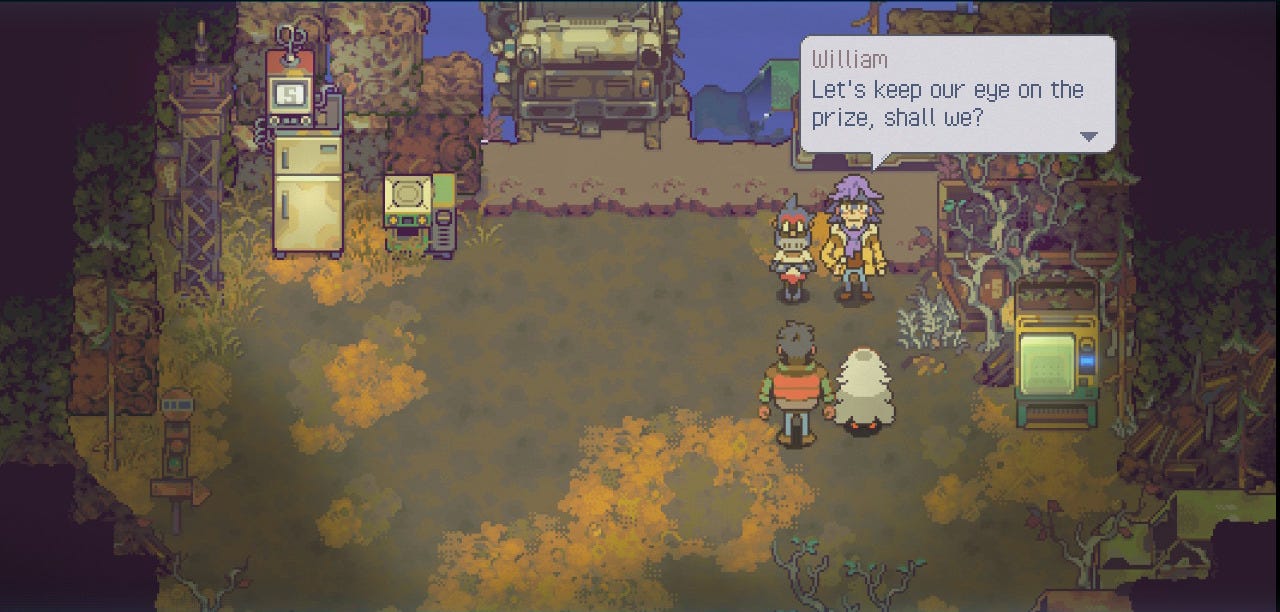
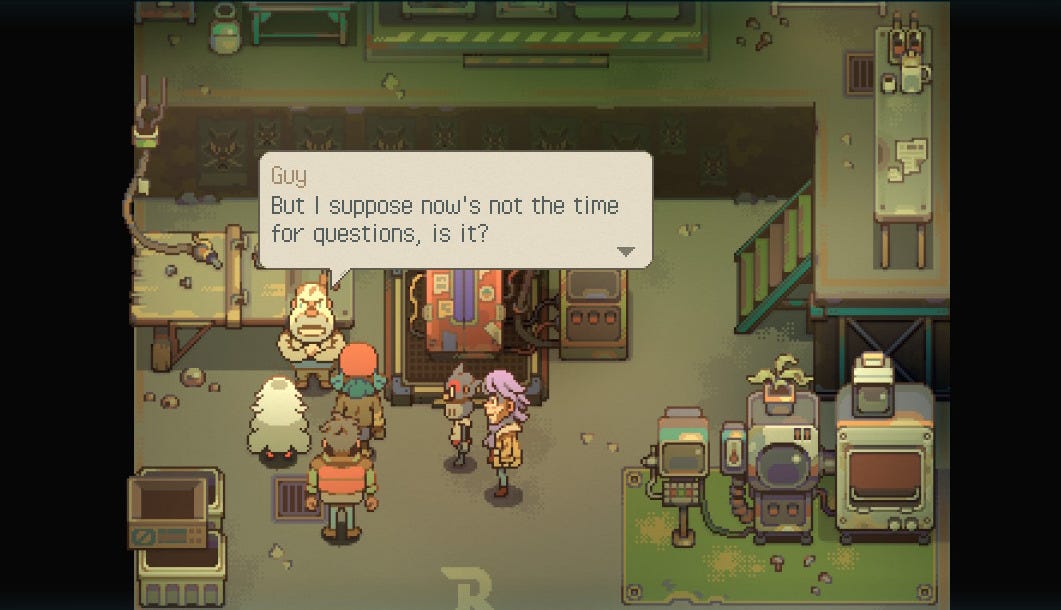
Remember, all characters are unvoiced; it’s speech bubbles only, and a little audio blip that goes along with that. But the game somehow manages to crystallize a clear recognizability to its characters. That is important: much of Eastward’s journey does feel like a pretext to get to know its characters, rather than the other way around. The meaning that all these spaces become imbued with, the meaning by which they become places, is tied to the people that you meet and deepen relationships with.
You can deepen your relationship with these characters because they too, in the way they are written, have their own elaborate mappings. They, too, are capable of meeting characters and having interactions that matter. It’s so hard to put a finger on that, but much of what happens in Eastward has to do with the characters within the world interacting amongst themselves. This whole notion of “interaction” is very hard to put down: what makes it so that you can meet someone and “do” things with them that gladden both? The answer calls for a complex evaluation, but maybe it simply boils down to having common things to care for, things in common that matter.
Now hold on to your seat because I just looked up the etymology of the word “matter”.
from Middle English, which took from Anglo-Norman, which took from Old French, which took...
from Latin materia (“wood”)
from Latin mater (“mother”)
cognate with old Armenian mayr (“cedar”)
and mayri (“forest”)
Thanks, Wiktionary, because it just so turns out that in the game’s overarching narrative, the main character Sam’s other name is... *drum roll*... MOTHER. Indeed, what other more basic and fundamental relationship, objective at that, than the one every individual, every animal, has with their mother...
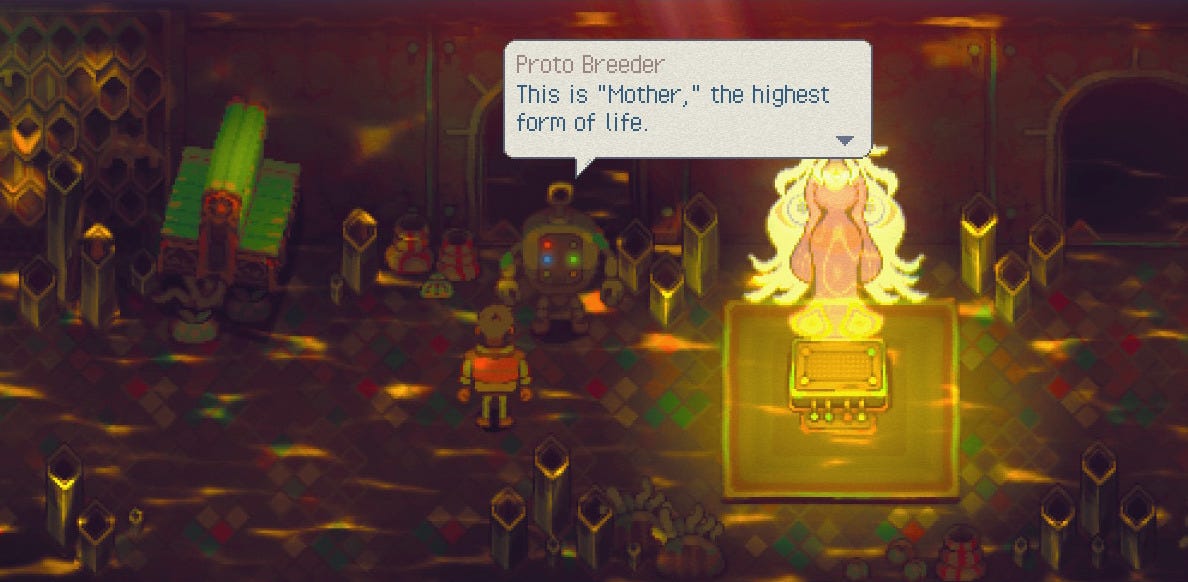
How satisfying to have arrived at such a result, that the notion of mattering should converge so conclusively with motherhood and Sam herself! (Not to mention the wood/tree/cedar/forest which goes all the way back to our LastOfUs x Aeneid post.) This becomes clearest towards the end of the game: that the way in which Eastward successfully pulls off its territorialization as symbolic appropriation of the world rests on the notion of (re)convergence, or recurring convergence. There’s that recurrence again, too!
The story has this thing where the same characters & motifs return in different forms & at different times. The great feeling (the more so as we approach the end) is that there seems to be a convergence:
Sam + John (“real” representation of the game)
EarthBorn (“game” representation of the game)
Monkollywood (“movie” representation of the game)
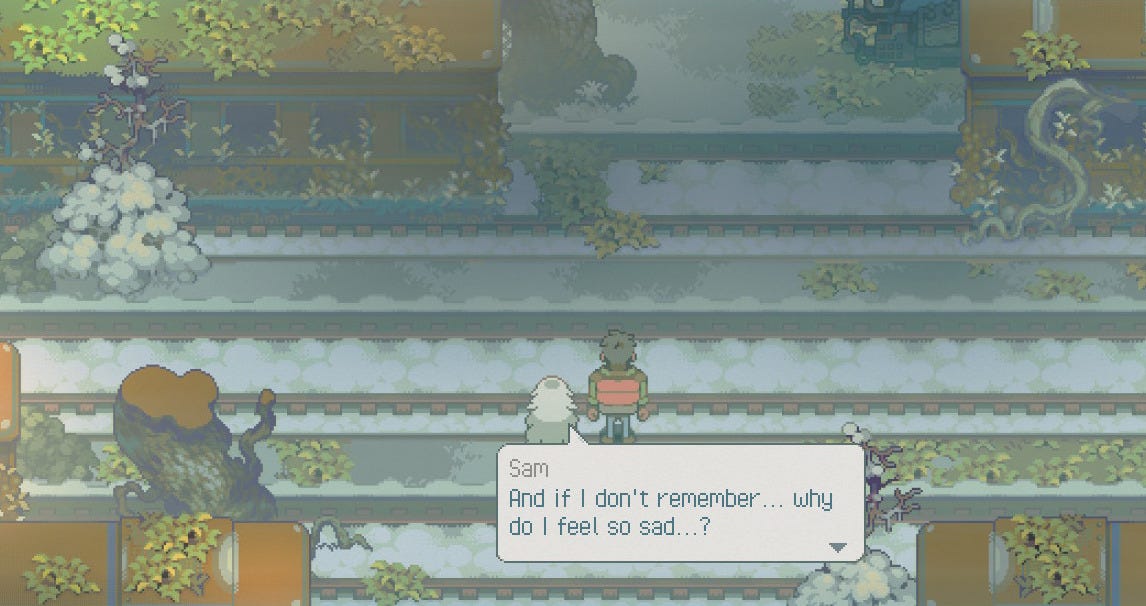
All of them are expressing the same thing and, at moments, pouring into each other’s trajectories. This seems to be the heart of the intrigue, the real engine of narration: the theme that we are caught in loops of ourselves, of the stories we tell ourselves, of the impetus that drives us, of the signs that we look for, of the omens we evaluate, of the trajectories we contemplate for ourselves and for others.
These are all mappings, stories about the places we’ve been and the places we’re going. In Monkollywood, the same train wagons are re-used with different decors, settings and activities. But you’re constantly aware of how they’re mapped to the same space that becomes a different place because of the stories that are enacted and the characters that are striving for what matters to them. In Ester City, you’re stuck in a time loop and it gives you the pretext to map the space out and the story that is happening in it, of which you are and are not a piece. Much of it feels like the time loop of our own repeating days. Repeating and waiting and working towards those moments of emotional catharsis.
These mappings are reinvested into the notion of memories.
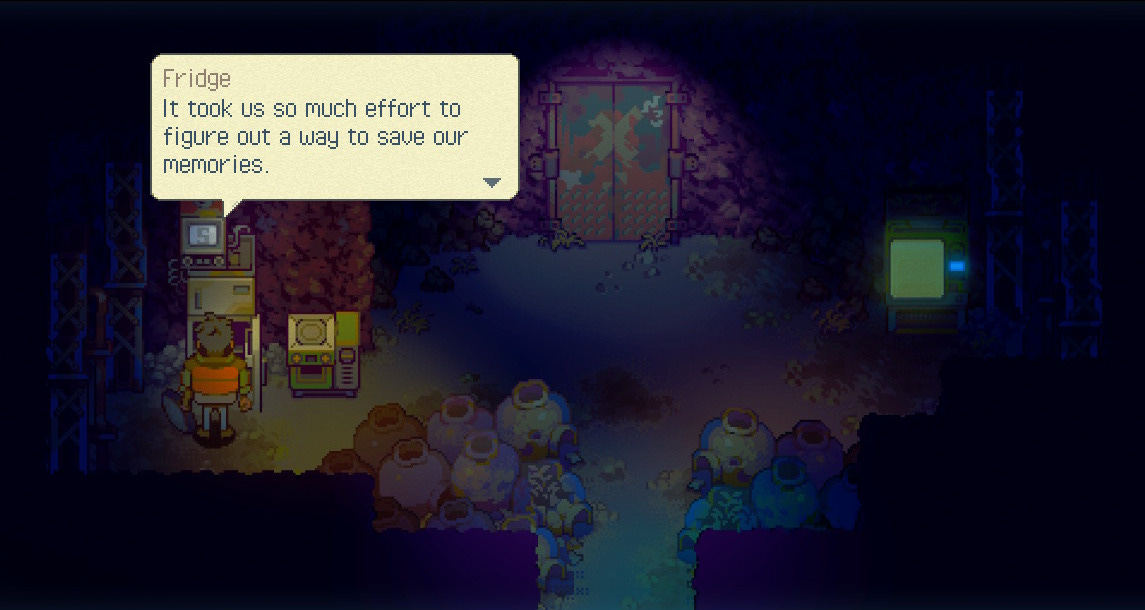
Eastward’s thesis is that you can break out of the loop because memories have a staying power that cannot be distorted, and they have this power because they only form when the moment matters. Isabel (whose name means “my god is my oath”) has lost what matters to her. She fights with all her life to never lose those memories. The fridges in which you save your game are constantly commenting about the notion of memory, as if they are taunting you to keep playing because if you want to save the game, it’s because the game has come to matter to you. There’s a divide between types of characters within the game: on one side, those that struggle for their humanity among the exploited (Potcrock) or those perceiving themselves to be a “lesser” race/type/origin (Frankenstein, monkeys, Zhivago, robots); on the other side, the shining stars of those who have embraced & developed their “humanity” (Sam, Alva, the children that play).
The only difference between the two types is that some did not or could not pursue the things that mattered to them, and it has deformed them. Yet others, through happy circumstance or strength of will, did pursue & temper what mattered, and this made them whole.
The end of the game might seem obscure to some. But it’s not; not if you understand what is going on. The end is exactly how the game began: you have to chase the cherished person, the one under your care. To one who enchants you, speaks for you, and is at the center of your cartography. But it’s also about coming to terms with what we’ve said before: strength of will can get you far, but there’s always objectivity, and sometimes that objectivity is insurmountable. Real monsters, the final bosses of the game, are those that could not let go, could not reconcile themselves with an objectivity that was stronger than their desire. They could not bring themselves to map reality and chose to live on the deformed aspect of a made-up map.
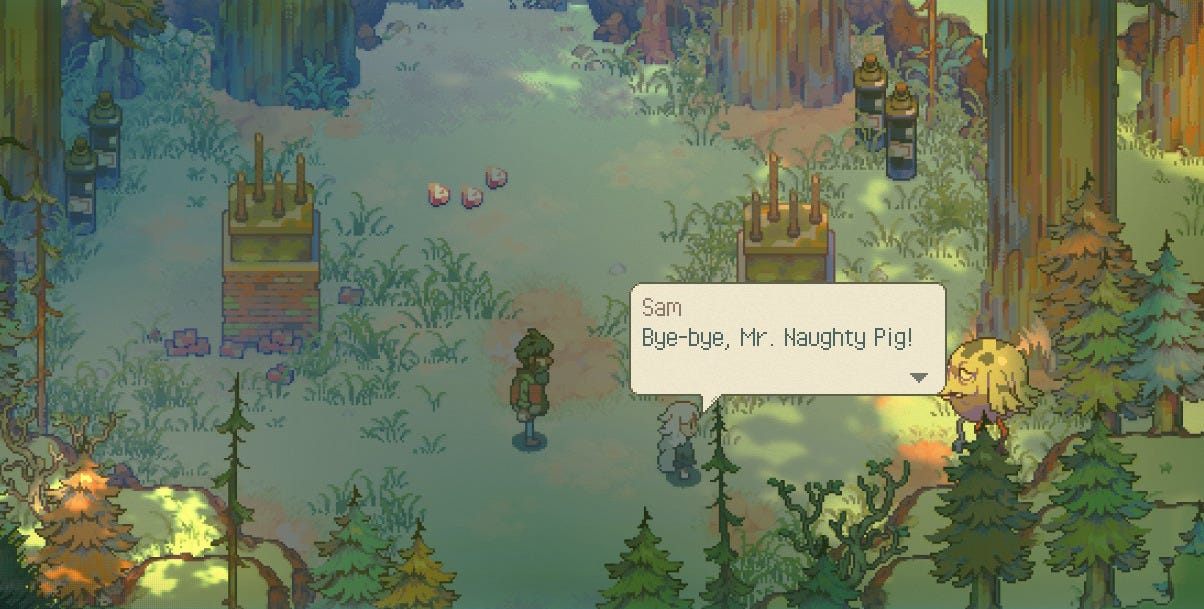
So comes a time for John, who doesn’t say a word all game, to have the strength of character to accept that the center of his cartography will need to stay in the hands of others. Objectivity will have taken place, and it’s up to others to do something with it or not. John becomes a drifter, no longer tied to place and map, a subject without object. The game kind of gives up and gives him what he wants in the epilogue, and that’s my biggest gripe with it. Although, it’s questionable at what point all of this is a dream and John is long dead by this time, so that’s also an interpretation (instead of admitting the developers sold out at the last possible moment).
Rolling up the map
Let’s stop here. We’ve thought about mapping in games, and we’ve looked in detail at two powerful examples revolving their whole gameplay around different dimensions of mapping: mapping of adversity and mapping of personality. Interestingly, both games, in the end, elaborate their method on a recurrent motif. In System Shock you come to understand that you need to use your head and stop overthinking. In Eastward you start feeling how the same story is being played out (and converges) in all the different mediums & memories of its world.
But this recurrent motif is not without ambiguity. The whole point of this post was to play along the lines of that antagonism between the abstract signaling of the map and the friction of reality. Signs are not reality, yet they are the only thing we have to work with. In this sense, both games figure as towering benchmarks of their field. Both manage in their own way to straddle the line that spans the complicated relationship of the mind with its cognitive map and its contact with reality.
I want to close by emphasizing, once again, the importance of immersion. If, as Doug Church would have it, computer games are to be more than fun ways to pass the time, I believe their potential to do so lies foremost in the specific kind of immersion they offer. Every art form has its way of immersing you, and games are specific in that almost all make you walk; make you open new lines of causality in their world. They induce you to map out (& over) their axes of abrasion. The best of them persistently push you to ferret out new ways by which to discriminate and appreciate the creativity that was put into them. They confront the player with the reality that some of its facets are nigh-inexhaustible in their aspiration. Such a Promethean promise is worth enjoying, remembering, and protecting.
1Cf. Borges’ story “On Exactitude In Science”.